Cart 0
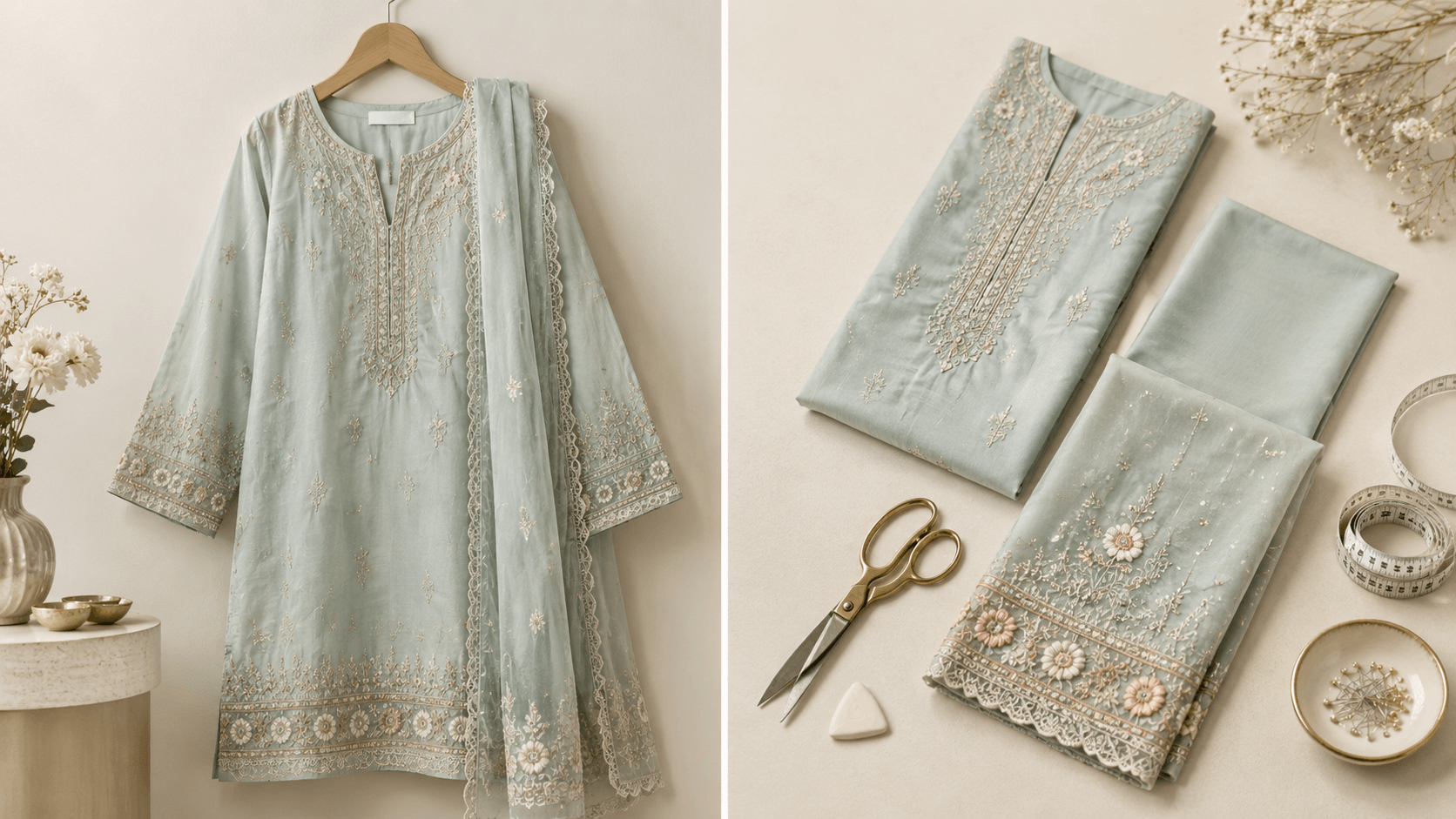

Pakistani suits are sold in several formats, including stitched, ready-to-wear, unstitched and semi-stitched. These terms affect what arrives in the package, whether tailoring is required and how sizing works.
Before ordering, always read the individual product description carefully. The number of pieces alone does not tell you whether a garment is ready to wear.
What does stitched mean?
A stitched Pakistani suit has already been sewn into a wearable garment. The shirt, trousers or other included pieces are finished according to a stated size or set of measurements.
A stitched product may still require small personal adjustments, such as:
- Shortening sleeves
- Adjusting trouser length
- Taking in the waist
- Changing the neckline
- Adding or moving fastenings
However, the main tailoring work has already been completed.
What does ready-to-wear mean?
Ready-to-wear normally means the garment is stitched and intended to be worn without full tailoring.
The terms stitched and ready-to-wear are often used together, but the product description should confirm exactly what is finished and included.
Ready-to-wear is usually the most convenient option for customers who:
- Want to wear the garment soon
- Do not have access to a Pakistani tailor
- Prefer to check fixed garment measurements
- Do not want to choose a custom cut
- Live in Sweden or elsewhere in Europe and want a simpler purchase
A ready-to-wear outfit is still size-dependent, so check the measurements rather than relying only on the label.
What does unstitched mean?
An unstitched Pakistani suit is supplied as fabric pieces rather than a completed garment. The fabric must be cut and sewn by a tailor.
An unstitched set may include fabric for:
- A shirt or kameez
- Trousers or shalwar
- A dupatta
The fabric may include printed placement, embroidered panels, borders, sleeves or decorative pieces that need to be positioned correctly during tailoring.
Unstitched products offer greater control over fit and style, but they require access to a suitable tailor.
What does semi-stitched mean?
Semi-stitched garments are partly constructed but not fully finished to a fixed size.
Depending on the design, this may mean:
- Some seams are already sewn
- The main shape is prepared
- The neckline or panels are assembled
- The garment still needs side seams, finishing or size adjustment
- Trousers may remain unstitched
There is no single universal definition of semi-stitched. Always check the specific product description to understand what work remains.
Advantages and disadvantages
Stitched and ready-to-wear suits
Advantages
- Convenient and quicker to wear
- No full tailoring appointment needed
- Finished shape is visible before purchase
- Product measurements can be compared directly
- Practical for customers living away from specialist tailoring services
Disadvantages
- Limited to the available size and cut
- Alterations may still be necessary
- A sold-out size may not return
- Less control over neckline, sleeve or trouser style
Unstitched suits
Advantages
- Can be tailored to personal measurements
- Greater choice over fit and finishing
- Shirt and trouser styles can often be customised
- Useful when standard ready-to-wear sizes do not fit well
Disadvantages
- Requires a capable tailor
- Adds tailoring time and cost
- The final result depends on cutting and stitching quality
- Placement embroidery or borders may require experience
- The outfit cannot normally be worn immediately
Semi-stitched suits
Advantages
- Some construction work is already completed
- May allow more size flexibility than a fully stitched garment
- Can reduce part of the tailoring work
Disadvantages
- The remaining work may not be obvious without a clear description
- Tailoring is still needed
- Flexibility depends on how much fabric and seam allowance remain
Tailoring requirements
For an unstitched or semi-stitched suit, confirm that a tailor can work with Pakistani clothing construction and any included decorative panels.
Before handing over the fabric:
- Photograph all pieces
- Check the brand’s layout or catalogue image
- Confirm where borders and embroidered panels belong
- Discuss finished shirt and sleeve length
- Agree on trouser style
- Keep labels and article information
- Ask how much fabric is available for alterations
Tailoring requirements vary, so avoid assuming that every three-piece set contains the same fabric quantities.
How sizes work for stitched garments
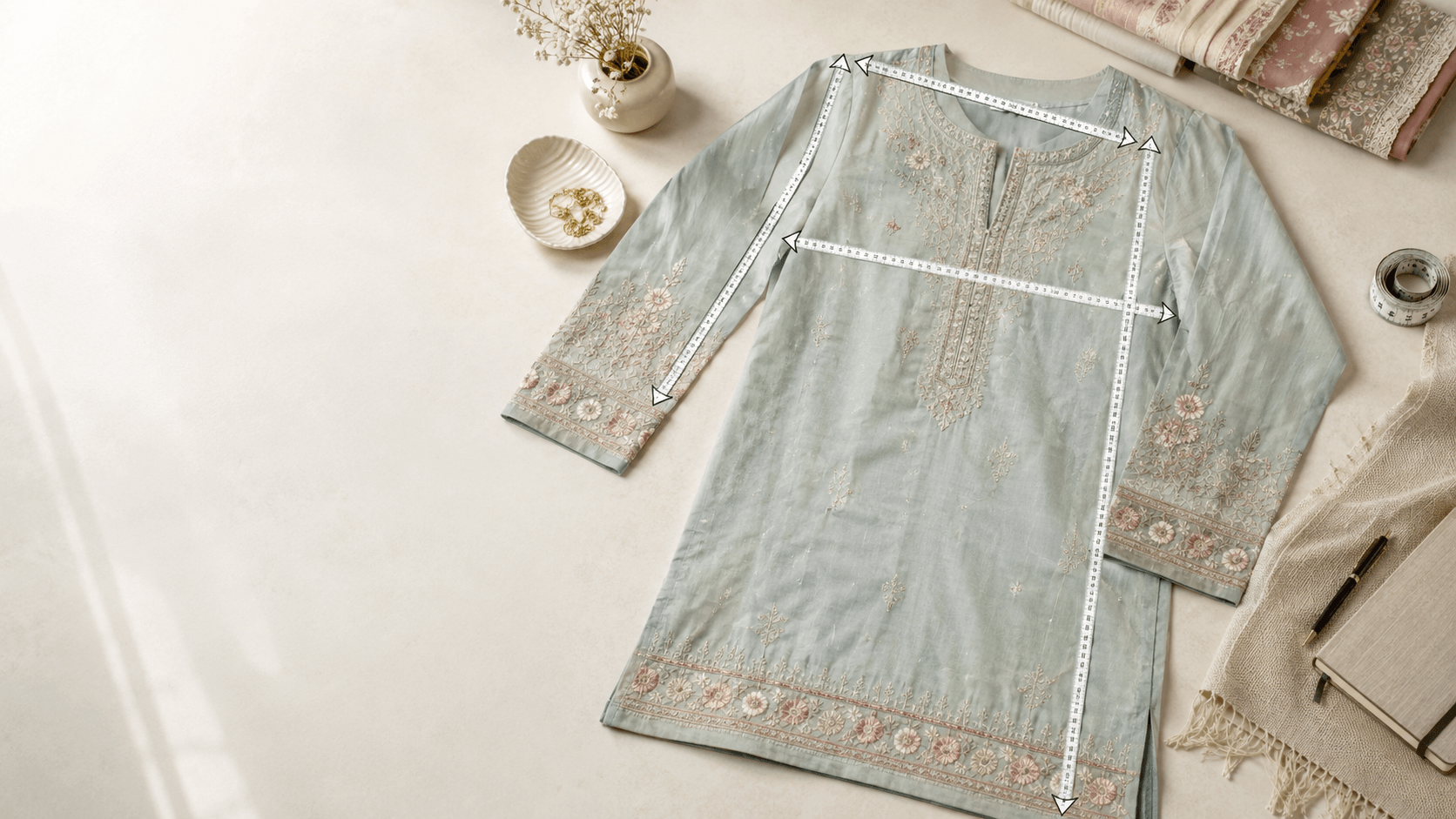
Stitched garments are sold according to a label size, actual garment measurements or both.
A label such as Medium does not guarantee the same fit across all designers. Check:
- Bust
- Waist
- Hip
- Shoulder
- Shirt length
- Sleeve length
- Trouser waist
- Trouser length
Use the Vinaz Size Guide and compare the listed measurements with a garment you already own.
For unstitched products, the label may refer to the collection or fabric set rather than a completed garment size.
What is included in one-piece, two-piece and three-piece sets?
The piece count describes the components included, but the exact contents can differ.
One-piece
A one-piece product may be:
- A stitched shirt or kurta
- A dress
- An unstitched shirt fabric
- Another single garment or fabric component
Browse one-piece dresses and kurtas and read each listing for the exact contents.
Two-piece
A two-piece set commonly includes:
- Shirt and trousers
- Shirt and dupatta
- Two coordinated fabric components
Browse Pakistani two-piece suits and check both stitched status and package contents.
Three-piece
A three-piece set commonly contains:
- Shirt
- Trousers
- Dupatta
However, it may be stitched, unstitched or a combination. Browse Pakistani three-piece suits and verify every included item.
Which option is practical in Sweden or Europe?
For many customers living in Sweden or Europe, stitched or ready-to-wear clothing is the simplest choice because no full tailoring is required.
It may be particularly practical when:
- You need the outfit for an upcoming event
- You do not know a suitable tailor
- You want to understand the finished fit before ordering
- You prefer a straightforward online purchase
Unstitched clothing may be better when:
- You want a custom fit
- Standard sizes do not suit your measurements
- You already use a trusted tailor
- You want to personalise the cut
Semi-stitched clothing sits between these options but still requires tailoring access.
Why the product description matters
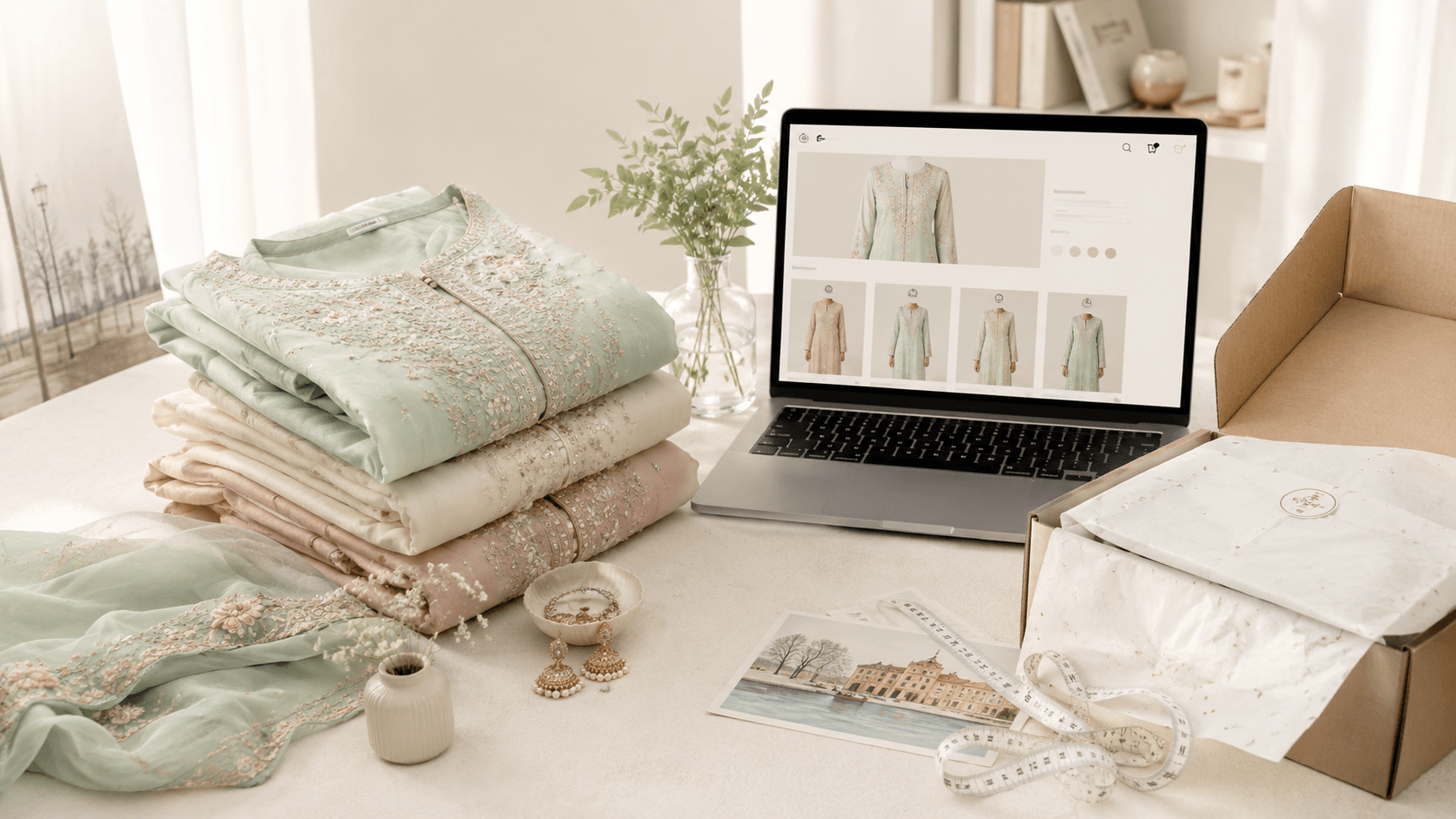
Never assume that a Pakistani suit is stitched because the catalogue photograph shows a model wearing it. Brand campaign images often show how an unstitched design can look after tailoring.
Before ordering, confirm:
- Stitched, unstitched or semi-stitched status
- Number of included pieces
- Exact package contents
- Label size
- Garment measurements
- Fabric details
- Whether accessories are included
- Whether tailoring is required
The Vinaz Shop lists available products, but each individual description should be treated as the main source for that item.
Frequently asked questions
Is ready-to-wear the same as stitched?
Usually, ready-to-wear means the garment is stitched and wearable. Still check the product description because small finishing or alterations may sometimes be needed.
Does a three-piece suit always arrive stitched?
No. A three-piece suit describes the number of components, not whether they are stitched. It may be stitched, unstitched or partly stitched.
Is unstitched clothing one size?
Unstitched fabric is not a completed garment size. The available fabric, panel dimensions and design placement determine how it can be tailored.
Which option is best when I do not have a tailor?
A stitched or ready-to-wear item is generally more practical. Check the exact measurements before ordering.
Can a stitched garment be altered?
Many stitched garments can be adjusted, but alteration options depend on seam allowance, design, fabric and construction.
Check before you order
Choose stitched clothing for convenience or unstitched fabric for customisation, but never rely on the product photograph alone. Review the measurements, stitched status and package contents before purchasing.
Browse the Vinaz Shop and compare current one-piece, two-piece and three-piece options.